El taller del coleccionista
Francesc Julià Ventura — Street in the old town with figures (1976) — Oil on canvas
Francesc Julià Ventura — Street in the old town with figures (1976) — Oil on canvas
Couldn't load pickup availability
Share
A narrow street opens up between aged facades and leads the eye toward a zone flooded with light. Francesc Julià Ventura here transforms an everyday urban scene into an exercise in perspective, matter, and color, dated 1976, at the height of his maturity.
The architecture occupies practically the entire composition. Balconies, windows, doorways, and walls follow each other on both sides of the street, but the artist avoids a meticulous description. The facades are built through overlapping brushstrokes of ochres, earths, grays, muted greens, and small reddish accents, letting the oil paint itself suggest the wear of the surfaces.
The perspective is clearly established: the buildings form a corridor leading toward the bright background. This light zone creates depth and contrasts with the denser tones in the foregrounds, especially with the large dark doorway on the right and the facades in shadow.
Within this architecture appear several small-scale human figures. A woman dressed in red advances down the center of the street; another figure, closer to the viewer, occupies the left side, while a small group fades into the background. Julià does not make them into portraits: a few brushstrokes suffice to give the street scale, movement, and everyday life.
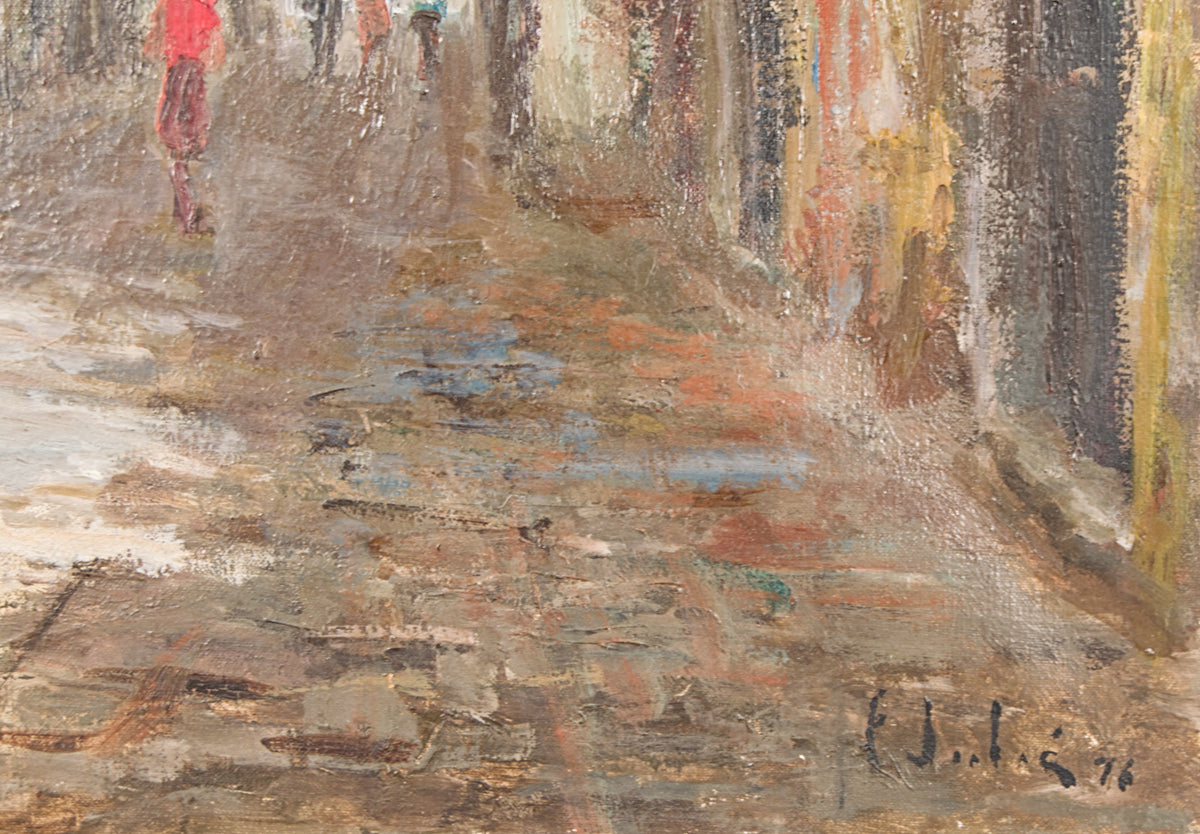
The pavement also deserves attention. Built through rapid strokes and stains of earth, blue, gray, and orange, it picks up the colors of the facades and helps to unify the entire composition. The brushstroke remains visible and spontaneous, especially in the foregrounds, while the architecture becomes progressively lighter as it recedes.
The result is an urban scene of an intimate character, in which the monumentality of the city gives way to what Julià Ventura observed repeatedly in his painting: lived-in streets, aged architecture, and the silent movement of those who cross them.
Francesc Julià Ventura — Landscape and City in 20th-century Catalan Painting
Francesc Julià Ventura (Sabadell, 1900) trained at the Sabadell School of Arts and Crafts under the direction of Joan Vila Cinca, one of the fundamental figures in Sabadell's artistic life at the beginning of the 20th century. In 1926, he moved to Barcelona and developed a body of work focused primarily on landscapes, seascapes, and urban scenes. euroartsubastas.es
His exhibition activity is documented from the 1940s and 1950s. In 1944 he participated in the National Fine Arts Exhibition with a work titled Llansá, and in 1949 he exhibited Bajo Montseny at the Real Círculo Artístico in Barcelona, a painting that was acquired by the Viscount of Güell, then president of the institution. euroartsubastas.es
His known work includes mountain landscapes, rural scenes, ports, and numerous urban views. References exist for works dedicated to Barcelona, Sabadell, and Paris, including Ramblas, Calle de la Catedral, Plaza San Agustín, and Río Sena. París. Gazette Drouot
The work we present belongs precisely to this urban side and is dated 1976, chronologically very close to other known city views by the artist.
The City as an Everyday Stage
Julià Ventura does not seek a monumental vision of architecture.
The street appears worn, irregular, and inhabited. The facades retain balconies, hanging laundry, open windows, and small chromatic alterations that suggest the passage of time. It is these details, more than the exact identification of the place, that construct the atmosphere.
The woman dressed in red constitutes a small but effective visual center. Surrounded by a predominantly earthy range, her figure introduces a chromatic accent that directs the gaze into the street.
The scene thus retains something of an everyday snapshot: a fragment of the city observed for a few seconds and subsequently transformed through painting.
Technical Data Sheet
Author: Francesc Julià Ventura (Sabadell, 1900)
Title: Street in the old quarter with figures
Date: 1976
Technique: Oil on canvas
Dimensions: 46 × 38 cm
Signature: Signed and dated “F. Julià 76” in the lower right corner
Subject: Urban scene with figures
Style: Figurative urban landscape
Period: Second half of the 20th century
Support: Canvas
Presentation: Unframed
Condition: Good general condition, with signs consistent with its age. The readability of the brushstrokes and the oil textures are correctly preserved. The photographs are part of the condition description.
Studio Note — The City on a Human Scale
What interests us about this painting is that the street does not function simply as a background.
The buildings rise up to occupy almost the entire canvas, but it is the small figures that provide meaning and scale to the architecture. The woman in red, the group walking away, and the figure in the foreground turn the space into a lived-in place.
Julià Ventura repeatedly worked on urban views, and this 1976 work is situated in a well-documented stage of that output. The contained format and vertical composition particularly accentuate the sensation of depth in the street.
A work representative of his urban landscaping, where matter, perspective, and everyday life are brought together in a simple but very effective scene.