El taller del coleccionista
FRANÇOIS ANTOINE AVELINE | CARTAGENA (FANTASTIC COLONIAL VIEW) | ORIGINAL 18TH-CENTURY ENGRAVING | CARTOGRAPHIC CURIOSITY
FRANÇOIS ANTOINE AVELINE | CARTAGENA (FANTASTIC COLONIAL VIEW) | ORIGINAL 18TH-CENTURY ENGRAVING | CARTOGRAPHIC CURIOSITY
Couldn't load pickup availability
Share
FRANÇOIS ANTOINE AVELINE | CARTAGENA (FANTASTIC COLONIAL VIEW) | ORIGINAL 18TH-CENTURY ENGRAVING | CARTOGRAPHIC CURIOSITY
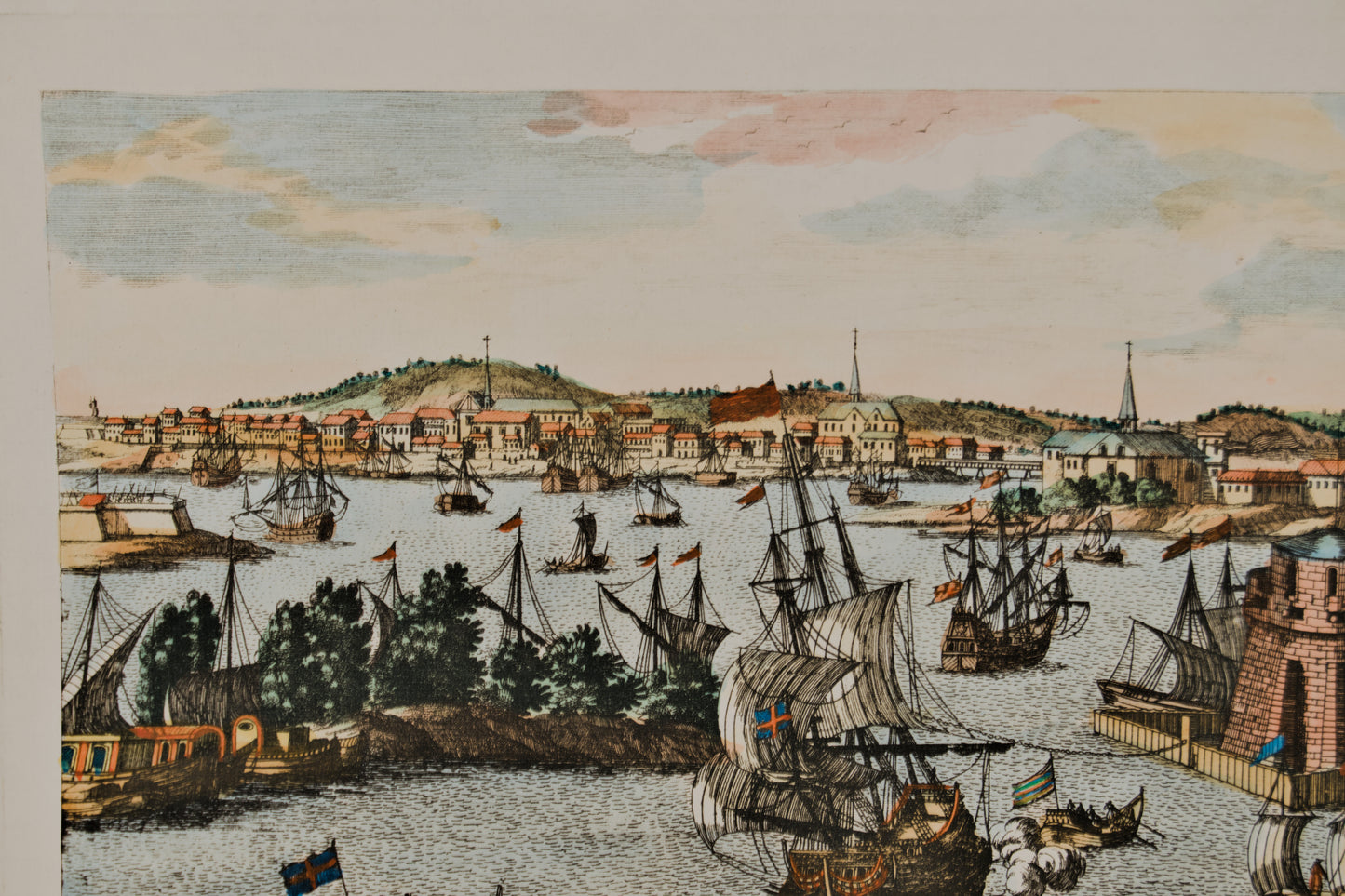
A rare 18th-century "Vue d'Optique" illustrating the European fascination with the colonies, mixing up Spanish Cartagena with Cartagena de Indias in a delightful historical error.
HISTORY AND CURATORIAL ANALYSIS
This engraving by François Antoine Aveline (1718-1780) is a gem for lovers of rarities. It belongs to the genre of Optical Views, images created in Paris to educate and entertain the public about distant cities. However, here Aveline makes a notable historical error: he titles the work "Cartagena, Town of Spain," but subtitles it "located in South America, near the Cauca River." In other words, he confuses Cartagena in Murcia, Spain, with Cartagena de Indias (Colombia) .
Visually, the work is an architectural fantasy. It depicts a fortified port with a circular defensive tower in the foreground (reminiscent of the Torre del Oro or Mediterranean fortifications) and a city in the background with spires reminiscent of European churches. The artist, who probably never visited either Cartagena, created an idealized image of a "rich and commercial port," filling the bay with galleons flying crossed flags (perhaps Burgundian or imaginary) firing smoke signals.
The period hand-coloring is vibrant, highlighting the choppy sea in the foreground and the invented exotic vegetation. It is a precious testament to how the 18th-century European imagination visualized the wealth of the colonies and Spanish naval power, blending reality and fiction.
WHY IS THIS PIECE AN OPPORTUNITY?
-
The Value of Error: In collecting antique maps and engravings, geographical "errors" add value. This engraving is proof of the common confusion of the time between the metropolis and the colonies. It's a guaranteed conversation piece.
-
Naval Aesthetics: The depiction of the ships is magnificent. We see tall galleons with their sails unfurled and rowboats with figures, all executed with Aveline's precise burin.
-
Rarity: While views of Paris or Rome are common, views of "Spanish/colonial" cities are much rarer in Aveline's catalogue.
-
State of Conservation: The work retains its margins and, most importantly, the complete textual legend where the historical curiosity of the "Cauca River" resides.
TECHNICAL SPECIFICATIONS
-
Author: François Antoine Aveline (Paris, 1718-1780). "Fait par Aveline CPR"
-
Title: Cartagene, Ville d'Espagne... scituée dans l'Amerique Australe (Cartagena... located in South America).
-
Period: 18th Century (Circa 1750-1780).
-
Technique: Etching and burin engraving on laid paper, hand-colored.
-
Dimensions: 50 x 32.5 cm (Visible footprint/paper).
-
Fun fact: Geographical error in the legend that places a city with European architecture in South America.
-
Provenance: Private collection.
-
Condition: Good. Fresh colors.
-
Inspection Guarantee: 14-day money-back guarantee to inspect the work in person.
THE WORKSHOP NOTE
This is my favorite piece in the series because of its historical "gaffe." Aveline drew a perfect European city, added warships, and placed it in the Colombian Caribbean without batting an eye. That's the magic of the 18th century: the image was meant for dreaming, not sailing. Decoratively, it's imposing, with that pink ashlar tower in the foreground and the choppy sea. A perfect piece for anyone who loves history, sailing, or geographical curiosities.
Includes Collector's Dossier: This work is delivered accompanied by a technical sheet and historical context prepared and printed by El Taller del Coleccionista, certifying our research.