El taller del coleccionista
FRANÇOIS ANTOINE AVELINE | NOTRE DAME AND THE ISLE OF SAINT-LOUIS | 18TH CENTURY ENGRAVING | HISTORICAL DOCUMENT OF PARIS
FRANÇOIS ANTOINE AVELINE | NOTRE DAME AND THE ISLE OF SAINT-LOUIS | 18TH CENTURY ENGRAVING | HISTORICAL DOCUMENT OF PARIS
Couldn't load pickup availability
Share
FRANÇOIS ANTOINE AVELINE | NOTRE DAME AND THE ISLE OF SAINT-LOUIS | 18TH CENTURY ENGRAVING | HISTORICAL DOCUMENT OF PARIS
An exceptional river panorama that rescues the lost architecture of aristocratic Paris and the daily life of the Seine.
HISTORY AND CURATORIAL ANALYSIS
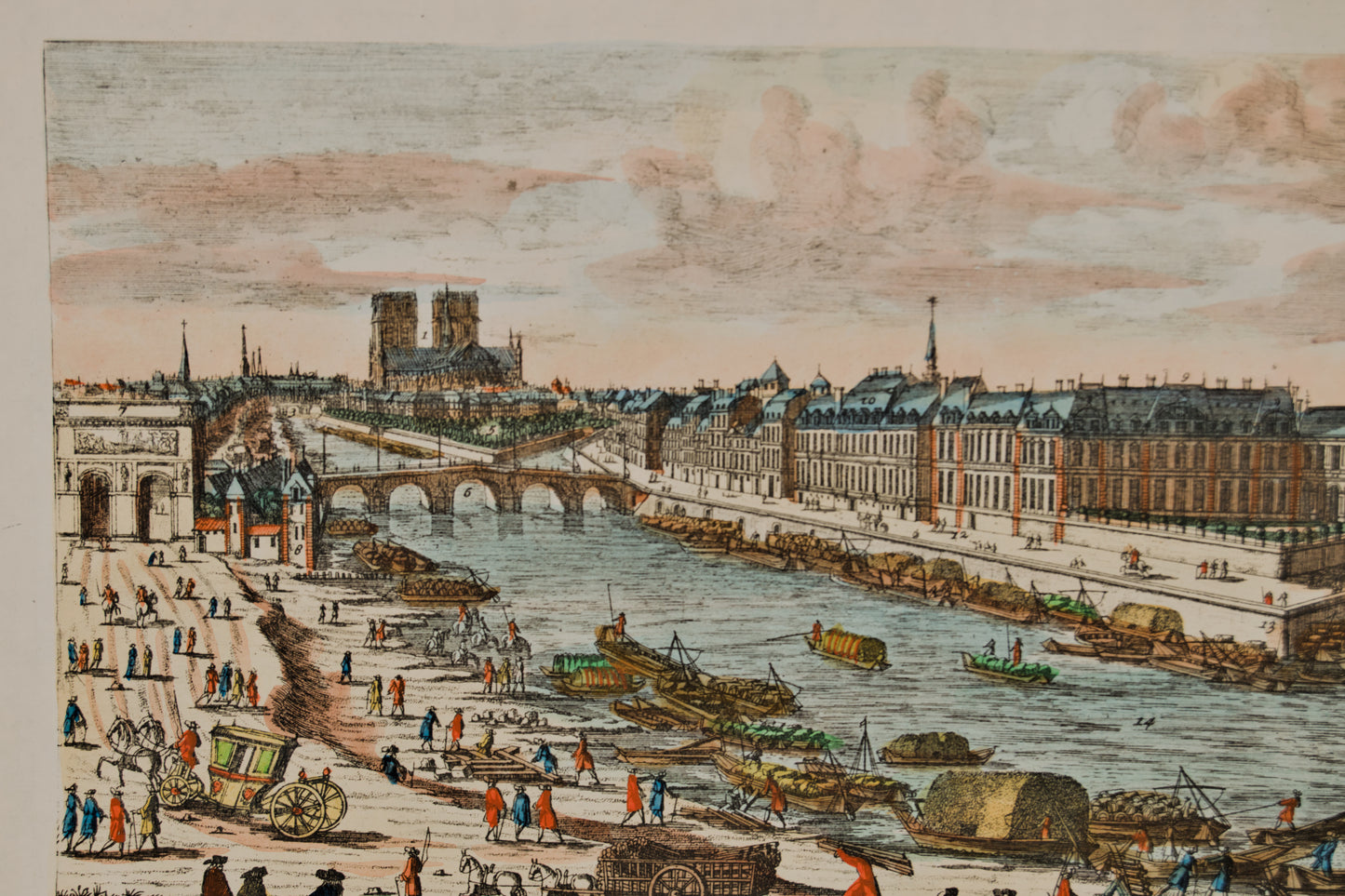
This Optical View by François Antoine Aveline (1718-1780) offers a privileged perspective of Paris during the Ancien Régime. The view is taken from the eastern shore of Île Saint-Louis (referred to in the caption as "Isle Nostre Dame"). What makes this print unique is that the focus is not only on Notre Dame Cathedral (visible in the background on the left), but also on the magnificent Hôtel de Bretonvilliers (the grand palace on the right). This building, with its gardens and terrace overlooking the river, was one of the most luxurious mansions of the 17th century and was demolished in 1874, making this engraving one of the few remaining visual records of its splendor.
The scene is a hive of activity. Aveline documents with ethnographic precision the river trades: we see the large floating wooden trains ( flottage du bois ) that arrived from the Morvan to heat the city, the washerwomen on the bank and the carriages of the nobility strolling along the quay.
The color treatment, applied by hand at the time, uses blues and aquamarines for the Seine and the slate roofs, reserving reds for the figures' clothing, thus guiding the eye through the crowd. The perspective is deep, drawing the viewer's gaze from the bustle of the foreground to the Gothic towers of the cathedral silhouetted against a clear sky.
WHY IS THIS PIECE AN OPPORTUNITY?
-
Urban Memory: It depicts a Paris that no longer exists. The Hôtel de Bretonvilliers is a "ghost building." To own an original engraving showing it intact is to possess a fragment of the city's lost history.
-
Iconography of Notre Dame: The silhouette of the cathedral appears with its original spire (preceding that of Viollet-le-Duc), which is a detail highly valued by historians and lovers of pure Gothic.
-
Visual Narrative: It's a work full of "micro-stories." If you look closely, you see gentlemen saluting, porters carrying bundles, horses drinking... It's a window into daily life in the 18th century.
-
Print Quality: Aveline's burin is sharp and precise, defining every stone of the bridge and every window of the palace with a mastery that has stood the test of 250 years.
TECHNICAL SPECIFICATIONS
-
Author: François Antoine Aveline (Paris, 1718-1780). "fait par Aveline à Paris avec Privil. du Roy."
-
Title: Veüe et Perspective de l'Isle Nostre Dame du costé de la Maison de Monsr. of Bretonvilliers .
-
Period: 18th Century (Circa 1750-1780).
-
Technique: Etching and burin engraving on laid paper, hand-lit.
-
Dimensions: 50 x 32.5 cm (Visible footprint/paper).
-
Legend: Text in French identifying 14 key points, including Notre Dame, the Hôtel Dieu and the Pont Marie.
-
Provenance: Private collection.
-
Condition: Good. The color remains vibrant and the paper is in good condition.
-
Inspection Guarantee: 14-day money-back guarantee to inspect the work in person.
THE WORKSHOP NOTE
What I love most about this print is that it's not your typical tourist postcard of Notre Dame. Here, the cathedral is part of the landscape, but the true protagonist is the river and the life that revolves around it. The inclusion of the Bretonvilliers Palace lends it an aristocratic and exclusive air. It's an elegant piece, perfect for hanging in a living room and explaining to visitors that the majestic building on the right no longer exists, but thanks to Aveline, it lives on on your wall.
Includes Collector's Dossier: This work is delivered accompanied by a technical sheet and historical context prepared and printed by El Taller del Coleccionista, certifying our research.