El taller del coleccionista
HENRY DRESSER | MARSH TITMOUSE | 19TH-CENTURY SCIENTIFIC ILLUSTRATION | ORIGINAL LITHOGRAPH
HENRY DRESSER | MARSH TITMOUSE | 19TH-CENTURY SCIENTIFIC ILLUSTRATION | ORIGINAL LITHOGRAPH
Couldn't load pickup availability
Share
HENRY DRESSER | MARSH TITMOUSE | 19TH CENTURY SCIENTIFIC ILLUSTRATION | ORIGINAL LITHOGRAPH
The rigor of science and the delicacy of Victorian art fused in a seminal ornithological print. A historical document that elevates nature observation to the category of high decoration.
HISTORY AND CURATORIAL ANALYSIS
The pinnacle of illustrated ornithology
During the second half of the 19th century, scientific illustration reached levels of technical and aesthetic perfection that have not been surpassed since. In this context, Henry Eeles Dresser (1838-1915) emerged as a monumental figure. This original lithograph is part of his magnum opus, "A History of the Birds of Europe" (published between 1871 and 1896), a work that not only revolutionized the taxonomy of the time but also became a cornerstone of bibliographic and artistic collecting. The plate transcends mere cataloging to offer a vivid and instinctive portrait of European fauna.
The visual analysis of the print reveals an absolute mastery of anatomical drawing. Dresser composes the scene with three specimens from the tit family: two Marsh Titmice (Parus palustris) in the upper area and a Northern Marsh Titmouse (Parus borealis) in the lower area. The execution of the plumage is extremely meticulous; the artist manages to convey the softness of the grays and browns against the assertiveness of the black cap that characterizes the species. The inclusion of the branch, foliage, and small insects is not merely decorative but places the specimen in its ecosystem, providing a botanical balance that enriches the interpretation of the work.
From a graphic perspective, 19th-century lithography is a testament to editorial craftsmanship. The transfer of the drawing to the lithographic stone allowed for an unsurpassable sharpness of line, capable of registering everything from the sparkle in the bird's eye to the rough texture of the bark. The paper used, which today presents the warm patina characteristic of the Victorian era, acts as a neutral background that emphasizes the chromatic sobriety and natural elegance of the composition.
WHY IS THIS PIECE AN OPPORTUNITY FOR YOUR COLLECTION?
-
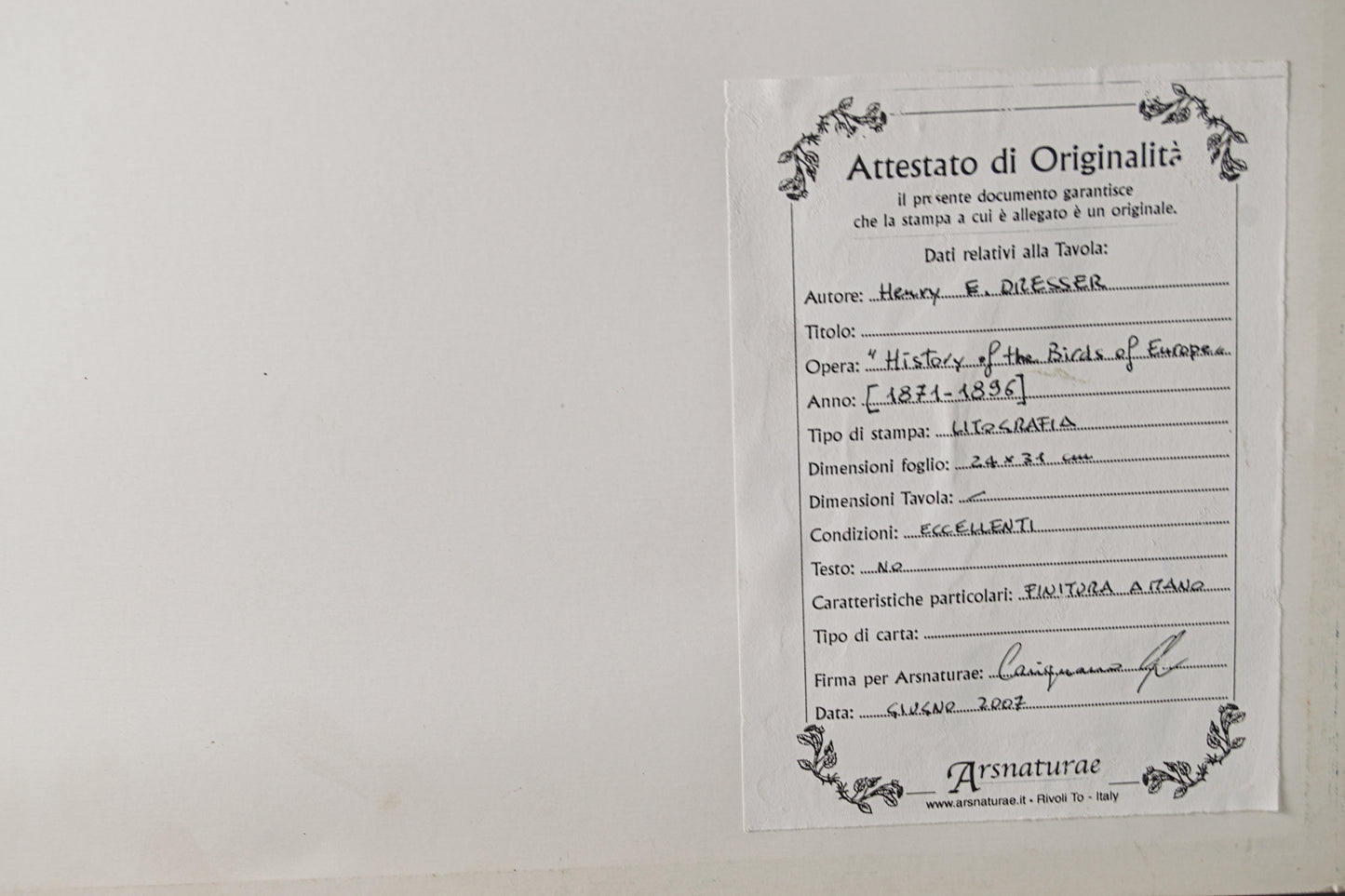
Documented Historical Rigor: Being part of the original edition of A History of the Birds of Europe positions this print as a first-rate scientific and artistic document, highly valued in the antique and naturalist collecting market.
-
"Cabinet of Curiosities" Aesthetic: Classic scientific illustration is a consolidated trend in high-end interior design. It provides an intellectual, cultivated, and serene character, ideal for offices, libraries, or reading rooms.
-
High-End Enhancing Framing: The presentation of the work multiplies its display value. The large-format textured blue passe-partout isolates the print and creates a sophisticated visual contrast, while the classic frame—in dark blue with gold profiles—interacts perfectly with the lithograph's palette and gives it an architectural scale.
TECHNICAL SPECIFICATIONS
-
Author: Henry Eeles Dresser (1838-1915).
-
Source Work: A History of the Birds of Europe (London).
-
Plate Title: 1. 2. Marsh Titmouse (Parus palustris). 3. Northern Marsh Titmouse (Parus borealis).
-
Period: Between 1871 and 1896 (19th Century).
-
Technique and Support: Original lithograph on period paper.
-
Dimensions: 24 x 31 cm (Visual work). Frame included.
-
Inscriptions: Typographic texts of scientific cataloging in the lower margin. Lithographer's monogram on the plate (lower center right).
-
Provenance: Private collection archive.
-
Condition: Very good. Stable paper with a slight, homogeneous antique patina that certifies its 19th-century origin.
-
Presentation: Professional and definitive framing. Wooden frame finished in blue and gold, and textured blue passe-partout.
-
Inspection Guarantee: 14-day guaranteed return to inspect the print in person and verify the rigor of the original lithograph.
THE WORKSHOP'S NOTE
When cataloging this piece, the decisive factor is its mounting. A print of these dimensions, if presented loose, might pass for a simple archive document; however, the selected professional framing—with that deep blue passe-partout that cools and balances the warm tone of the Victorian paper—transforms it into a striking easel piece. It is a strategically impeccable acquisition for the collector looking to combine the historical rigor of an author like Dresser with immediate and elegant visual impact.
Includes Collector's Dossier: This work comes with an exhaustive research study, technical sheet, and historical context, prepared and printed by El Taller del Coleccionista.