El taller del coleccionista
Jordi Bastit — El Graller — Original etching (final proof)
Jordi Bastit — El Graller — Original etching (final proof)
Couldn't load pickup availability
Share
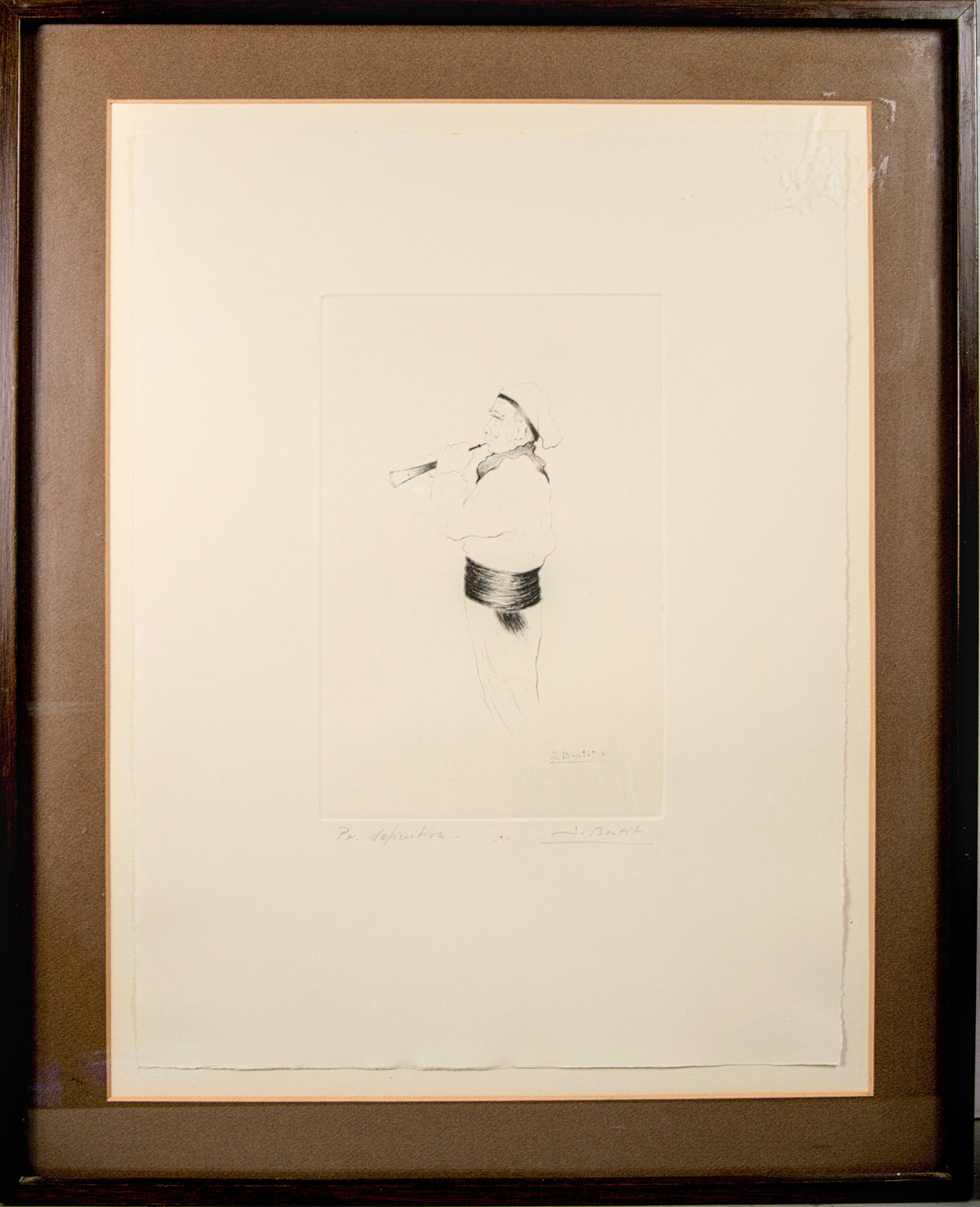
A work representative of Catalan popular culture. In this etching from 1980, Jordi Bastit captures a traditional musician—the graller—with a clean, direct line that reflects his technical command of etching.
The musician as an icon
The graller is an important figure in Catalan folklore and traditional music. Bastit approaches him with remarkable economy: he dispenses with elaborate backgrounds and incidental elements to focus entirely on the performer’s gesture. Etching defines the musician’s silhouette, the folds of his clothing and the structure of the instrument with an almost calligraphic clarity, giving the figure a restrained dignity.
Technical execution
The work stands out for its purity of line. It is printed on heavyweight paper, which gives the line body and presence. The plate signature and date («J. Bastit. 80»), together with the pencil signature and handwritten inscription «Pr. definitiva» in the margin, identify a proof of excellent printing quality.
Technical details
Artist: Jordi Bastit.
Title: El Graller (Catalan folklore / traditional music).
Date: 1980.
Technique and support: Etching on heavyweight paper.
Artwork dimensions: 45 × 33.5 cm. With frame: 57 × 46 cm.
Signature: Signed and dated in the plate «J. Bastit. 80». Hand-signed in pencil «J. Bastit», with the inscription «Pr. definitiva» in the margin.
Provenance: Private collection.
Condition: Excellent overall condition.
Inspection period: 30-day guaranteed return period to examine the work in person and assess its quality.
The Taller’s note
The figure is shown in profile, with the gralla pointing to the left and the hands gathered in front of the face. The background is left undrawn, so the outlines of the musician and instrument stand out against the light tone of the paper. Lines are concentrated in the neckerchief and sash, whose dark areas contrast with the shirt and cap. Towards the bottom, the drawing becomes lighter and leaves some edges of the figure open.