El taller del coleccionista
JOSEP TRIADÓ | EX-LIBRIS FOR FIDEL GIRÓ (1902) | ORIGINAL WOODCUT | CATALAN MODERNISM
JOSEP TRIADÓ | EX-LIBRIS FOR FIDEL GIRÓ (1902) | ORIGINAL WOODCUT | CATALAN MODERNISM
Couldn't load pickup availability
Share
JOSEP TRIADÓ | EX-LIBRIS OF FIDEL GIRÓ (1902) | ORIGINAL WOODCUT | CATALAN MODERNISME
The art of printing immortalized by the absolute master of the ex-libris in Spain. An original museum-quality woodcut that documents the graphic excellence and editorial history of Barcelona at the beginning of the 20th century.
HISTORY AND CURATORIAL ANALYSIS
The Revival of Graphic Arts
In Catalonia in 1900, engraving ceased to be a mere industrial reproduction technique and was elevated to the category of Fine Arts, becoming the expressive vehicle for the soul of Modernisme. Josep Triadó i Mayol (1870-1929) was the great standard-bearer of this revival, and this piece is one of his most masterful testimonies.
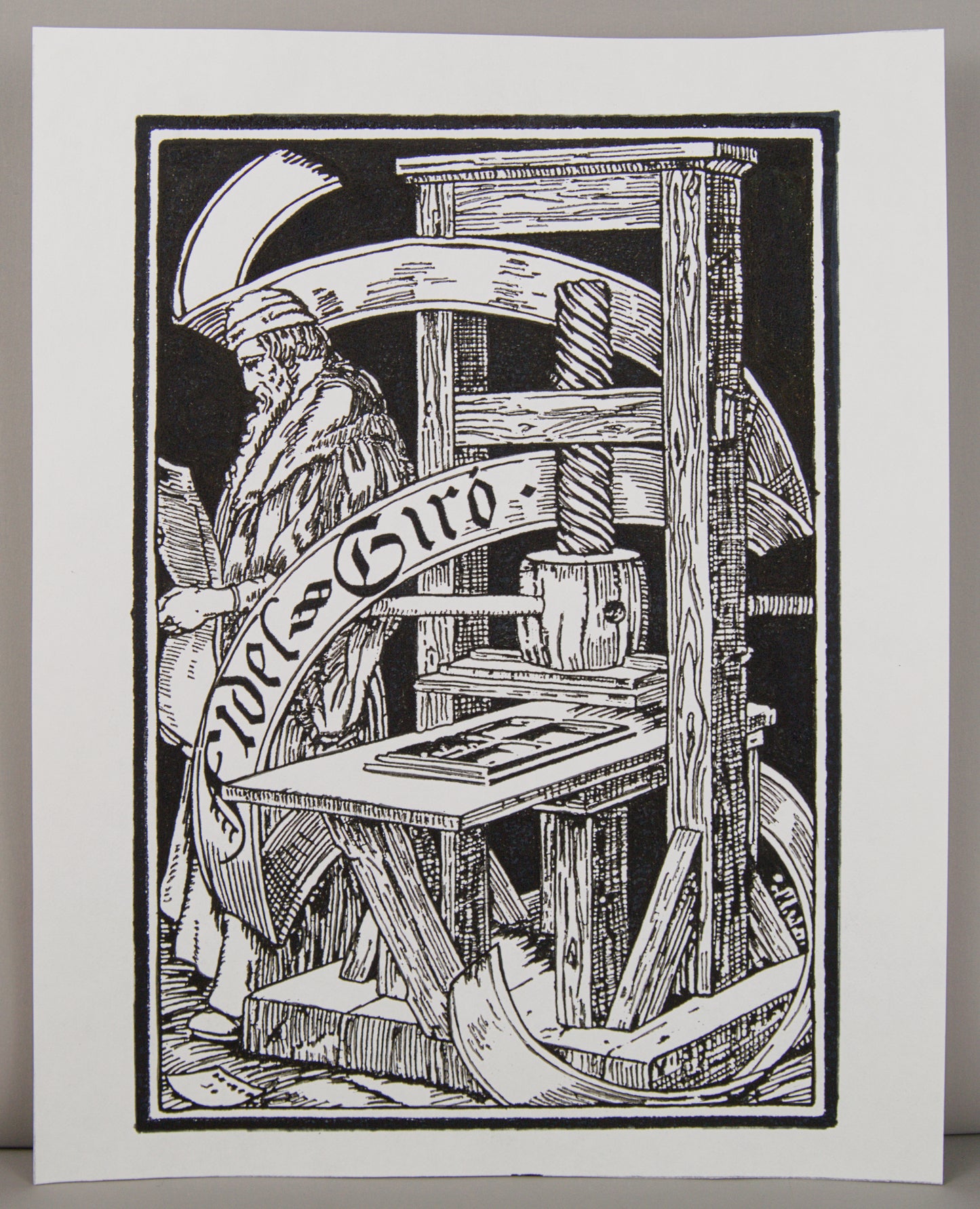
Identified in the catalogues raisonnés as the Ex-libris of the legendary printer Fidel Giró (Opus 36, dated 1902), Triadó offers us a scene laden with profound guild symbolism: the figure of a period printer —evoking Gutenberg himself— meticulously examines a proof freshly taken from an imposing screw press (cargol press).
The Virtuosity of Wood and the Philactery
The composition possesses astonishing visual and structural strength. The radical and dramatic contrast of black and white, characteristic of carved wood (woodcut or relief engraving), accentuates the heaviness of the machinery and the atmosphere of a craft workshop. It is exceptional to observe how the large phylactery (the scroll or ribbon) bearing the name "Fidel Giró" intertwines and snakes through the robust timbers of the press with an organic elegance and undeniable Art Nouveau style. It is the perfect union between the brute force of industry and the delicacy of modernist design.
WHY IS THIS PIECE AN OPPORTUNITY FOR YOUR COLLECTION?
-
Cataloged and Museum-Quality Piece: This print is referenced in major academic studies and repertoires on the history of European ex-libris (Op. 36 of Triadó's catalogue). Its importance transcends aesthetics to become a foundational document of contemporary graphic design.
-
Historical Editorial Link: Representing Fidel Giró (1849-1926), one of the key figures in Barcelona's printing industry and intellectual circles, makes this work the "holy grail" for collectors of guild themes, bibliophiles, and lovers of book arts.
-
Printing Quality (Cabinet Proof): Unlike ex-libris that are glued and damaged by time, this example boasts extraordinarily wide and clean paper margins, and a black print of very high saturation that allows reading even the author's signature/monogram carved in the lower right corner of the matrix.
TECHNICAL DATA SHEET
-
Author: Josep Triadó i Mayol (Barcelona, 1870 - 1929).
-
Title / Theme: Ex-libris of Fidel Giró / Printer at the screw press (Graphic Arts / Bibliophilia).
-
Year of creation: 1902 (Cataloged as Op. 36).
-
Technique and Support: Original woodcut (relief engraving) printed on paper with wide margins.
-
Documented Dimensions: Support: Approx. 22.5 x 17.5 cm (Impression / Graphic image of classic ex-libris proportions).
-
Signature and Inscriptions: Artist's monogram carved on the plate in the lower right corner. Owner's name "Fidel Giró" integrated into the composition.
-
Style / Movement: Catalan Modernisme / Art Nouveau.
-
Provenance: Graphic collection / Private collection.
-
Condition: Excellent archival quality.
THE WORKSHOP NOTE
Owning this engraving means holding in your hands the historical encounter between the best printer of an era and the greatest artist of the graphic ownership mark. Triadó did not draw a simple label; he erected a portable monument to the dissemination of knowledge. An absolute jewel of bibliophilia designed to preside over the library of a rigorous collector who venerates the origin of the modern book.
Includes Collector's Dossier: This work comes with a research study of the work, prepared and printed by El Taller del Coleccionista, certifying our research and known provenance.