El taller del coleccionista
JUAN LÓPEZ (AFTER B. VAUTIER) | "THE ARREST" (DIE VERHAFTUNG) | DÜSSELDORF SCHOOL | 19th century GRAPHIC WORK
JUAN LÓPEZ (AFTER B. VAUTIER) | "THE ARREST" (DIE VERHAFTUNG) | DÜSSELDORF SCHOOL | 19th century GRAPHIC WORK
Couldn't load pickup availability
Share
JUAN LÓPEZ (AFTER B. VAUTIER) | "THE ARREST" (DIE VERHAFTUNG) | DÜSSELDORF SCHOOL | 19th century GRAPHIC WORK
A masterful translation into printmaking of one of the most tense and celebrated genre paintings of 19th-century German realism.
HISTORY AND CURATORIAL ANALYSIS
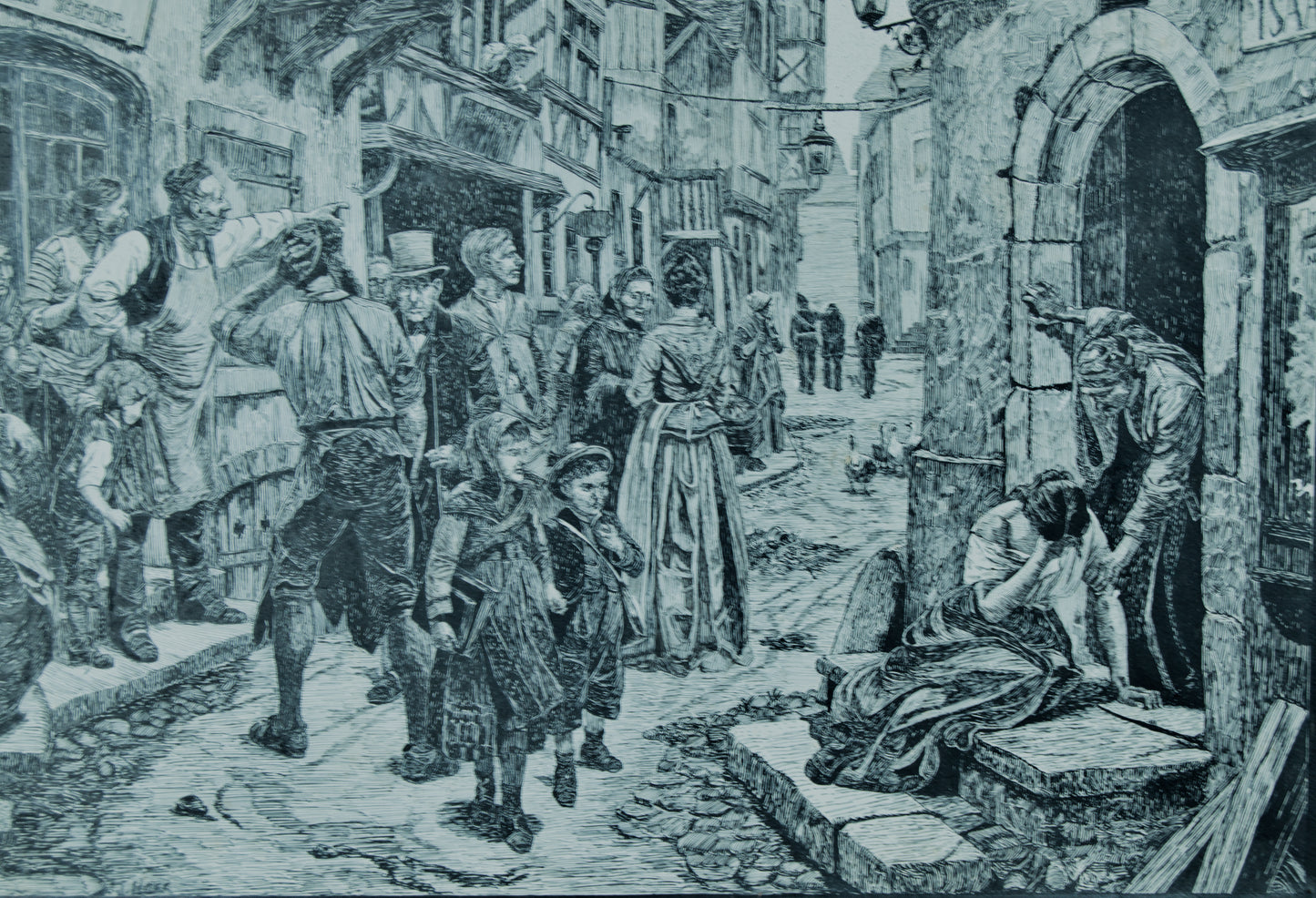
This print, signed by Juan López, is a copperplate interpretation of Benjamin Vautier 's celebrated painting "Die Verhaftung" (The Arrest), a cornerstone of the Düsseldorf School. In the 19th century, before the advent of mass photography, printmakers like López were responsible for democratizing great masterpieces, translating the color of oil paint into the binary language of ink with almost mathematical precision.
The scene now takes on a full meaning: it's not just any eviction, it's the arrest of a con artist or white-collar criminal . Vautier was famous for his ability to grasp the psychology of a crowd, and López brilliantly translates that to the page here.
-
The Conflict: We see the exact moment when the authorities (in the background, wearing tricorn hats or helmets) take the detainee away, while the community reacts. The baker (wearing an apron) points accusingly, passing moral judgment.
-
The Intimate Drama: The woman crying in the foreground, collapsed on the stairs of the marked house (sign "ISAAC" or similar), represents family shame and social ruin, a recurring theme in the realist literature of the time.
-
Setting: The architecture is unmistakably German/Swiss (timber framing), reflecting the environment where Vautier developed his career.
WHY IS THIS PIECE AN OPPORTUNITY?
-
Connection to Art History: By acquiring this work, you are not just buying a drawing; you are buying a direct reference to a masterpiece of European genre painting that hung in the most prestigious salons of the 19th century.
-
Narrative of "Crime and Punishment": It is a scene with a brutal psychological charge. The tension between public rejection (the neighbors pointing) and private pain (the wife crying) transforms the scene into a complete visual novel.
-
The Engraver's Virtuosity: Juan López demonstrates here why interpretive engraving was a major art form. Notice how he differentiates the texture of the stone, the old wood, and the silk of the woman's dress using only lines. It's a technical feat.
-
A Rarity in the Spanish Market: Finding prints from the Düsseldorf School signed by Spanish artists is very uncommon. It's a collector's item for those seeking cross-border rarities.
TECHNICAL SPECIFICATIONS
-
Author: Juan López (Engraver/Draftsman), based on the work of Benjamin Vautier (1829-1898).
-
Title: The Arrest (Die Verhaftung).
-
Time period: Late 19th century.
-
Technique: Ink / Etching on paper.
-
Dimensions: 42 x 55 cm.
-
Signature: Signed "J. López" on the plate.
-
Provenance: Private collection.
-
Condition: Good. Paper with a natural cream tone. The image retains excellent sharpness in the blacks.
-
Inspection Guarantee: 14-day money-back guarantee to inspect the work in person.
THE WORKSHOP NOTE
What strikes me about this print is how Juan López managed to capture the coldness of that German street using only black ink. Vautier's original plays with dark colors, but López had to create light by scratching the paper. The figure of the woman is heartbreaking; she is the emotional heart of the work. It's a perfect piece for anyone who enjoys deciphering the hidden stories behind images.
Includes Collector's Dossier: This work is delivered accompanied by a technical sheet and historical context prepared and printed by El Taller del Coleccionista, certifying our research.