El taller del coleccionista
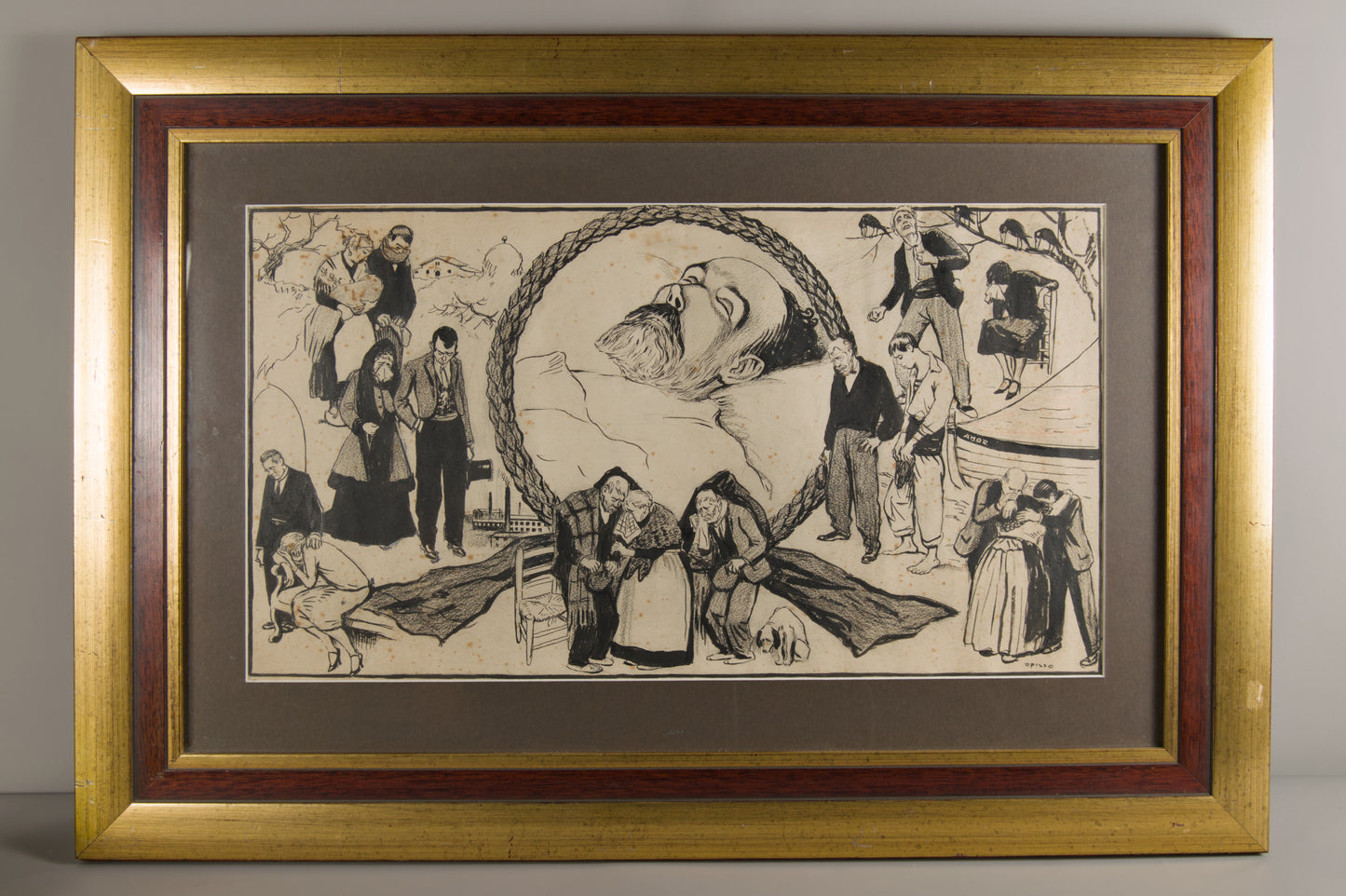
Attributed to Ricard Opisso | Funeral of the Poet Iglésias (1928) | Historical Drawing
Attributed to Ricard Opisso | Funeral of the Poet Iglésias (1928) | Historical Drawing
Couldn't load pickup availability
Share
A visual testimony and tribute to Barcelona in 1928. A graphic document from the era where social chronicle transforms into a personal elegy, capturing the essence of Catalan Modernism.
History and Curatorial Analysis
The story behind the stroke To understand the magnitude of this piece, we must place it at the heart of the cultural effervescence of early 20th-century Catalonia. We are not looking at a mere representation of an artist and a poet; we are witnessing the historical intersection of two fundamental figures. Ricard Opisso (1880-1966) was the great graphic chronicler of the Els Quatre Gats generation, and Ignasi Iglésies established himself as one of its most celebrated playwrights and social poets. This work, attributed to Opisso's hand due to his unmistakable stroke and technique, is not a journalistic report but an intimate farewell.
The document behind the work The definitive context of this piece is provided by an extraordinary handwritten note on its reverse, which documents Iglésies' funeral in 1928 and reveals three fundamental facts for its cataloging:
-
The Emotion: The inscription "Ho va dibuixar plorant" (He drew it crying) shows that there was no impartial spectator, but a peer bidding farewell. This emotional charge justifies the nervous stroke and the dense atmosphere that envelops the scene.
-
The Composition: The human tide depicted on the paper is not an anonymous mass; it is Barcelona society paying tribute. As a stroke of compositional genius, the center does not depict a coffin, but the framed face of the poet, standing as the spiritual epicenter of the mourning.
-
The Uniqueness: The note concludes with an invaluable piece of information for any archive: "L'unic retrat que existeix de l'enterrament" (The only existing portrait of the burial).
Why is this piece an opportunity for your collection?
-
Exceptional Historical Document: As the only known portrait of the poet during his funeral, its documentary value transcends the purely aesthetic. It is a first-rate study and archive piece.
-
Intersection of Masters: The work encapsulates the direct connection between the great visual chronicler of the era and one of its most respected literati, uniting two pillars of Catalan culture on the same medium.
-
Transparency and Market Value: The piece features the characteristic signature of the author and superb technical execution. Cataloged rigorously as an attributed work, the collector has the opportunity to acquire a fragment of museum-quality history at a highly competitive investment value.
Technical Sheet
-
Author: Attributed to Ricard Opisso i Sala (1880-1966).
-
Title: Enterrament del Poeta I. Iglesias (Burial of Poet I. Iglesias).
-
Year: 1928.
-
Technique and Support: Period ink on paper.
-
Dimensions: 31.5 x 57 cm (Work) | 54.5 x 79.5 x 2.5 cm (Frame).
-
Signature and Inscriptions: Features the inscription "Opisso" in the lower right corner. Includes a handwritten historical note on the reverse.
-
Provenance: Private collection.
-
Condition: Very good. Shows slight foxing (natural paper oxidation) consistent with its age, certifying its era without affecting the integrity of the drawing. Delivered with frame if desired.
The Workshop's Note
This work perfectly represents the rigor and heritage rescue that we advocate. It is not just a drawing with a high technical level; it is a piece with a documented and palpable story. The handwritten note on the reverse immediately elevates it from a mere print to a historical testimony of great caliber. It is an acquisition designed for the erudite collector who seeks to connect directly with the emotion and memory of Barcelona in 1928.
Includes Collector's Dossier: This work is accompanied by an exhaustive research study, technical sheet, and curatorial context prepared and printed by El Taller del Coleccionista, certifying the stylistic argumentation of the attribution and the transcription of its documented provenance.