El taller del coleccionista
The story and fable of Orpheus — Orpheus among the animals — original ink illustration on paper
The story and fable of Orpheus — Orpheus among the animals — original ink illustration on paper
Couldn't load pickup availability
Share
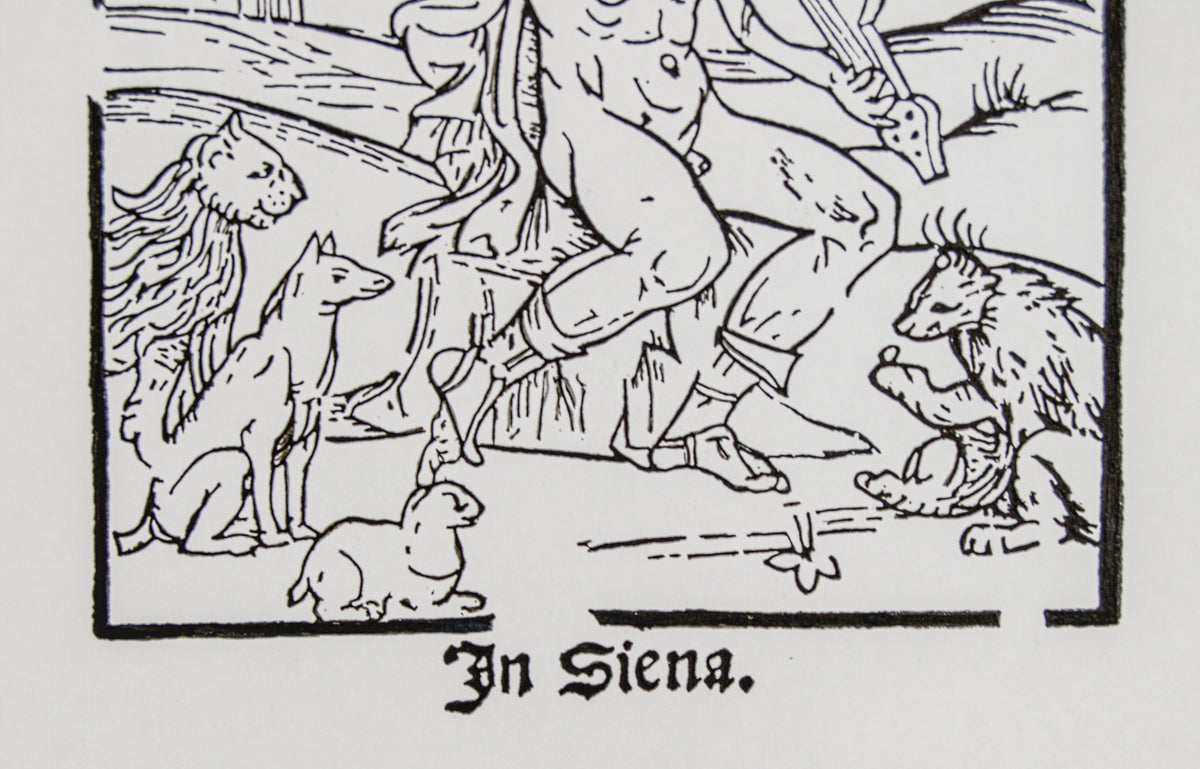
Orpheus occupies the center of the composition, playing a stringed instrument while various animals gather around him. Dogs, a rabbit, and fantastical-looking creatures seem to listen to music that, according to the myth, was capable of taming even wild beasts.
Above the image, an inscription in Italian introduces the story of Orpheus and Eurydice and his famous descent into the underworld. At the bottom appears the phrase “In Siena”, deliberately completing the appearance of an old Italian print.
However, we are not looking at a historical print: this is an original hand-drawn illustration on paper, coming from a collection related to publishers and illustrators. Its author consciously reproduces the visual language of ancient woodcuts to construct an image likely intended for later editorial reproduction.
The Work
The composition is executed in black ink on paper, with a very clean line drawing and absolute contrast between the white of the medium and the dark areas.
The illustrator works with a deliberately archaic vocabulary. The figures are outlined with thick contours, the animals are rendered schematically, and the landscape is reduced to a few houses, mountains, and ground lines. Even the fragmented frame surrounding the scene contributes to simulating the irregularities of an old woodblock matrix.
The typography is also part of the illustration. The heading, traced to imitate ancient characters, reads:
“La Storia e favola di Orfeo: il quale per la morte di Euridice volle andare nel Inferno.”
The reference comes from the long Italian tradition of popular tales dedicated to Orpheus. During the 15th and 16th centuries, various versions of the Historia et favola d’Orpheo circulated, frequently accompanied by woodcuts in which the musician appeared surrounded by animals or playing instruments contemporary to the time of printing.
The present piece recovers precisely that imagery, but from a modern graphic recreation intended for the publishing field.
Orpheus and the Tradition of Early Prints
The myth of Orpheus enjoyed immense popularity during the Renaissance. His love for Eurydice, his descent into the world of the dead, and the supernatural capacity of his music allowed a classical narrative to be transformed into a story easily recognizable to the general public.
In numerous old images, Orpheus appears surrounded by animals tamed by his music. Renaissance illustrators also had no problem replacing the ancient lyre with instruments that were familiar to their own contemporaries.
This work seems to be directly inspired by that language of Italian popular books and pamphlets, reinterpreting it through a particularly careful manual technique.
Technical Data Sheet
Title: La storia e favola di Orfeo – Orpheus among the animals
Chronology: 20th century
Technique: Black ink on paper
Dimensions: 27 × 18 cm
Type of work: Original editorial illustration
Inscriptions: “La Storia e favola di Orfeo: il quale per la morte di Euridice volle andare nel Inferno” / “In Siena”
Subject: Orpheus and Eurydice, classical mythology, music
Signature: No visible signature
Provenance: Collection linked to publishers and illustrators
Conservation status: Good general condition, with small signs consistent with the paper and its use as a graphic original.
Workshop Note
What interested us most about this piece was discovering that it is not printed.
At first glance, it functions perfectly as an old woodcut: archaic typography, thick black lines, almost fantastical animals, and a composition that could have come from a small 16th-century Italian book. Upon direct observation, however, it is clear that everything has been executed by hand.
This makes the piece something different: an original editorial illustration created to look old. The illustrator not only reproduces a mythological scene, but also the very visual materiality of early prints. Within a collection related to publishers and draftsmen, this preparatory character is especially attractive.