El taller del coleccionista
YVES BRAYER | HORSES IN THE CAMARGUE | FRENCH FIGURATION | COLOR LITHOGRAPH
YVES BRAYER | HORSES IN THE CAMARGUE | FRENCH FIGURATION | COLOR LITHOGRAPH
Couldn't load pickup availability
Share
YVES BRAYER | HORSES IN THE CAMARGUE | FRENCH FIGURATION | COLOR LITHOGRAPH
The light of the French Mediterranean captured by the great visual chronicler of Provence.
HISTORY AND CURATORIAL ANALYSIS
Yves Brayer (1907-1990) is one of the leading figures of 20th-century French figurative painting. Far from succumbing to the pressure of abstraction that dominated his era, Brayer remained faithful to the study of reality, becoming the definitive interpreter of the landscapes of southern France, specifically Provence and the Camargue. His work does not seek photographic detail, but rather aims to capture the stark and luminous atmosphere of the Mediterranean through a solid and structured technique that earned him his own museum in Les Baux-de-Provence.
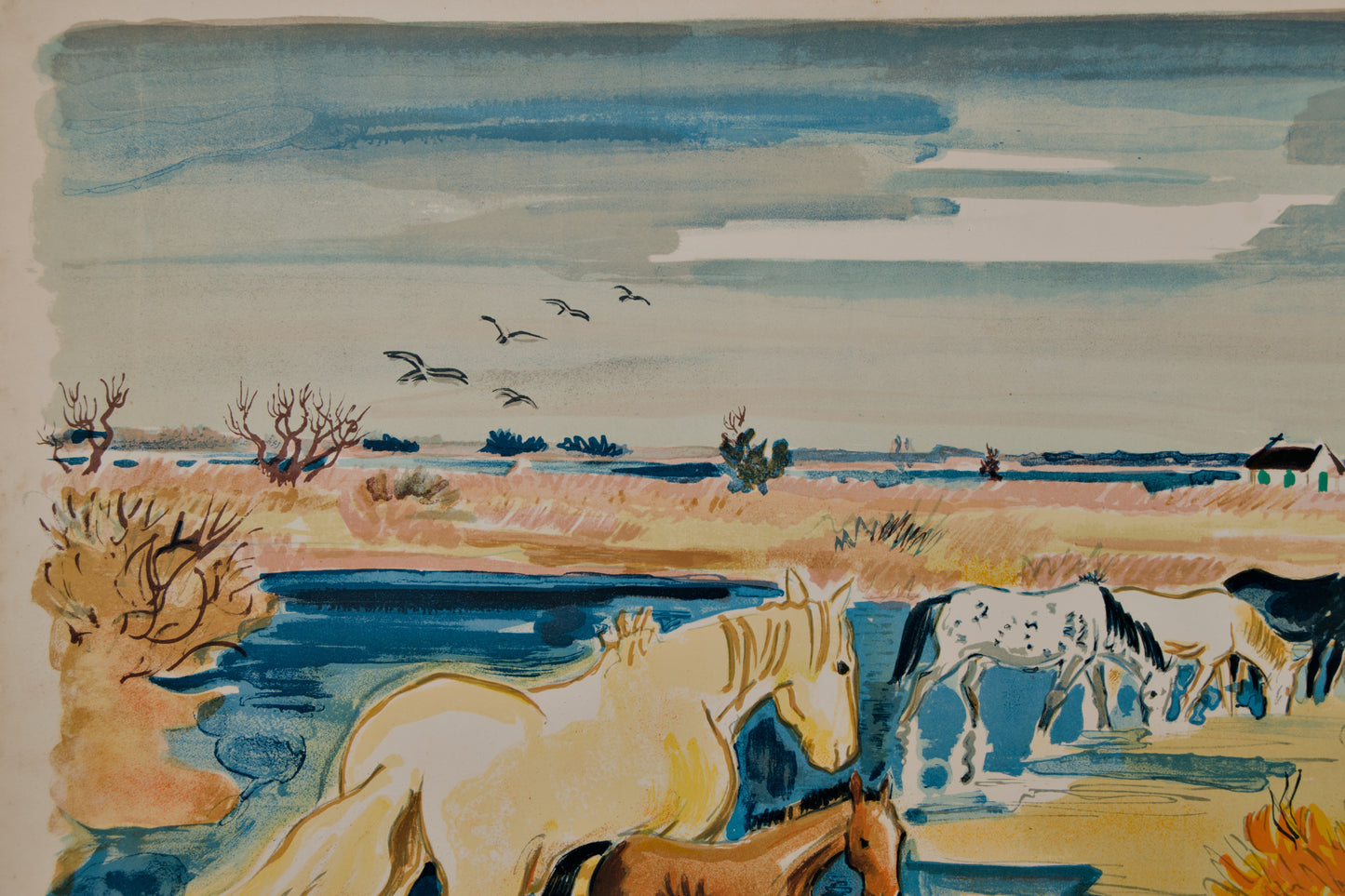
In this lithograph, the artist displays his most celebrated iconography: the wild white horses of the Camargue in their wetland environment. The composition is built upon a vigorous black drawing that delineates the forms of the horses and the vegetation, subsequently filled with planes of watercolor in cerulean blue, ochre, and earth tones. Brayer uses the white of the paper to give substance to the main horses, allowing the light to emanate from the figures themselves, while the background is rendered with horizontal bands that suggest the vastness of the marsh.
The piece stands out for its descriptive economy. It is not necessary to paint every blade of grass; the quick, gestural brushstrokes of the foreground bushes and the simplified depiction of the birds (possibly egrets) immediately place the viewer in the ecosystem of the Rhône Delta. The chromatic balance between the warm earth tones and the blues of the water creates a relaxed visual harmony, characteristic of the "joie de vivre" of Provençal art.
WHY IS THIS PIECE AN OPPORTUNITY?
-
Relevance/Signature: Yves Brayer is a "safe bet" in French art. Acquiring a Brayer painting with Camargue themes (horses and water) is like acquiring a Sorolla beach scene; it's the subject for which he became famous.
-
Uniqueness/Rareness: The format is generous (almost 70 cm wide), allowing one to appreciate the fluidity of the lithographic stroke. It is not a minor sketch; it is a finished and complex composition with multiple figures.
-
Aesthetics/Decoration: Earth tones and blue are neutral and elegant. This piece works exceptionally well in country houses, vacation homes, or urban spaces seeking a touch of natural calm.
-
Support/Condition: Lithography allows access to the master's aesthetic with a reasonable investment. The image appears clean, and the colors maintain their tonal distinction without becoming muddy.
TECHNICAL SPECIFICATIONS
-
Author: Yves Brayer.
-
Title / Topic: Horses and foals in the Camargue.
-
Era: Second half of the 20th century.
-
Technique and Support: Color lithograph on paper.
-
Dimensions: 56.5 x 67.5 cm.
-
Signature: Signed in the plate (part of the print) in the lower right corner: "Yves Brayer".
-
Provenance: Private collection.
-
Condition: Very Good. Paper slightly tanned with age (typical of the period), image sharp.
-
Inspection Guarantee: 14-day money-back guarantee to inspect the work in person.
THE WORKSHOP NOTE
We added this piece to the catalog because it represents the "canonical Brayer." When a collector seeks out this artist, they are looking for precisely this: the synthesis of the wild nature of southern France. I am particularly interested in how he renders the anatomy of horses with very loose, almost sketch-like black lines, which nevertheless demonstrate a profound understanding of animal structure. It is a work that is easy on the eyes; it has air, depth, and a color palette that conveys immediate warmth.
Includes Collector's Dossier: This work is delivered accompanied by a technical sheet and historical context prepared and printed by El Taller del Coleccionista, certifying our research and known provenance.